The Gini Coefficient measures concentration rather than diversity. A low Gini value means submitted liquidity is spread relatively evenly across many observations, while a high Gini value means a small number of submissions account for a large share of the activity. In practical terms, a rising Gini often indicates that order flow is becoming dominated by a few outsized additions instead of many similarly sized updates.
Mathematics
This metric computes the standard sample Gini coefficient on the observed submissions after sorting the observations, using . Here denotes the sorted observation values and is the number of samples. On the bid side it uses order wealth, , while on the ask side it uses submitted amount directly, so the bid series reflects concentration in notional commitment and the ask series reflects concentration in size. Values closer to indicate equality across samples, while values closer to indicate stronger concentration.
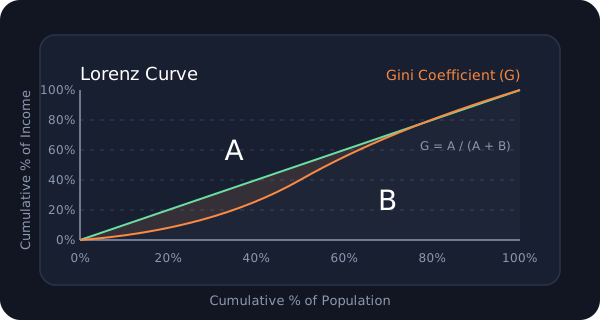
The same idea can be visualized with the Lorenz curve, which plots the cumulative share of observations on the horizontal axis against the cumulative share of submitted size or wealth on the vertical axis after sorting from smallest to largest. If every observation contributed equally, the curve would follow the 45-degree line of equality. When activity is concentrated in a smaller subset of observations, the Lorenz curve bows farther below that diagonal because the early portion of the sample contributes relatively little and the cumulative share only rises sharply near the end.
Geometrically, the Gini coefficient is the normalized area between those two curves: the line of equality and the Lorenz curve. A perfectly even distribution has zero enclosed area and therefore , while greater concentration increases the gap and pushes upward toward . This is why the metric is useful here: it turns the visual notion of "how far the distribution bends away from equal participation" into a single comparable number.